August Toronto Real Estate Market

(Based on August 2026 sales, as reported in September. Toronto Specific)
Hello friends!
Well, summer is officially winding down, and it looks like the Toronto real estate market spent most of August doing exactly what we would expect it to do this time of year...
Taking it easy.
After the stronger activity we saw during the spring, July brought a noticeable slowdown, and August continued that trend.
Fewer homes came to market. Fewer homes sold. Active inventory continued to decline, average prices softened across most property types and homes generally took longer to sell.
But before we get too carried away with the doom and gloom, there's an important piece of context.
July and August are typically the slowest months of the year for real estate.
People are on vacation, kids are out of school, cottages are calling and, let's be honest, when it's 30 degrees outside, buying or selling a home isn't always at the top of everyone's priority list.
So, a slower August isn't particularly surprising.
What is interesting is how the market slowed down.
Because while sales dropped across every property type, new listings also dropped significantly and active inventory continued to decline.
In other words, buyers slowed down...
But sellers did too.
And that makes the August numbers a little more interesting than they might appear at first glance.
📈 Big Picture General Takeaways
The biggest takeaway from August is that the summer slowdown continued, and in some areas it became even more pronounced.
New listings declined across every property type compared to July, with semi-detached homes seeing the largest drop at 45.9%.
Detached listings fell 41.4%, freehold townhomes dropped 41.9%, condo townhome listings declined 31.4% and condo apartment listings fell 21.0%.
That's a pretty substantial reduction in the number of new properties coming onto the market.
Sales also declined across every single property type.
Detached sales fell 30.6%, semi-detached sales dropped 41.1%, freehold townhome sales declined 54.1%, condo townhome sales fell 13.7% and condo apartment sales decreased 21.3%.
So yes, buyer activity clearly slowed in August.
But here's where things get interesting.
Active listings also declined across every property type.
That's important because if sellers had continued listing homes at the same pace while buyers disappeared, we'd expect inventory to pile up.
Instead, fewer sellers entered the market at the same time that fewer buyers were making purchases.
That tells us August wasn't simply a case of buyers walking away from Toronto real estate.
It was more like both sides took a summer vacation.
Before We Get Into the Numbers
August is a good reminder that real estate statistics need context.
Looking only at sales, you could easily conclude that the market took a major step backwards.
And there is no question that sales were lower across every category.
But then you look at new listings and see that supply also dropped dramatically.
Then you look at active inventory and see that it continued to decline.
Then you look at days on market and see that properties are generally taking longer to sell.
And finally, you look at prices and see that most categories softened, although the declines were more modest in some segments than others.
Put all of those pieces together and the picture becomes much clearer.
August looks like a slow summer market, not necessarily a sudden market collapse.
And that's an important distinction.
The big question is whether this is simply the normal summer lull or whether some of these trends continue once the summer season is behind us.
For now, let's get into the numbers.
You've read my personal opinion, but now here are the cold, hard numbers. 📊
Please note that these statistics cover only the City of Toronto. Not Richmond Hill, Not Mississauga, Not Vaughan, etc. If you would like to know what's happening in another area in the GTA, please reach out and let me know. I'm happy to chat!
Want to look on your own and see the numbers for yourself? Just ask and I'll send you the official statistics that every Real Estate agent gets sent from TRREB and uses for their market updates.
These are the exact numbers I use for my Toronto updates and, if you want, I can prepare an update as detailed as this blog update for your city, neighbourhood and even street/building!
Don't be shy, reach out and just ask!
📊 NEW LISTINGS
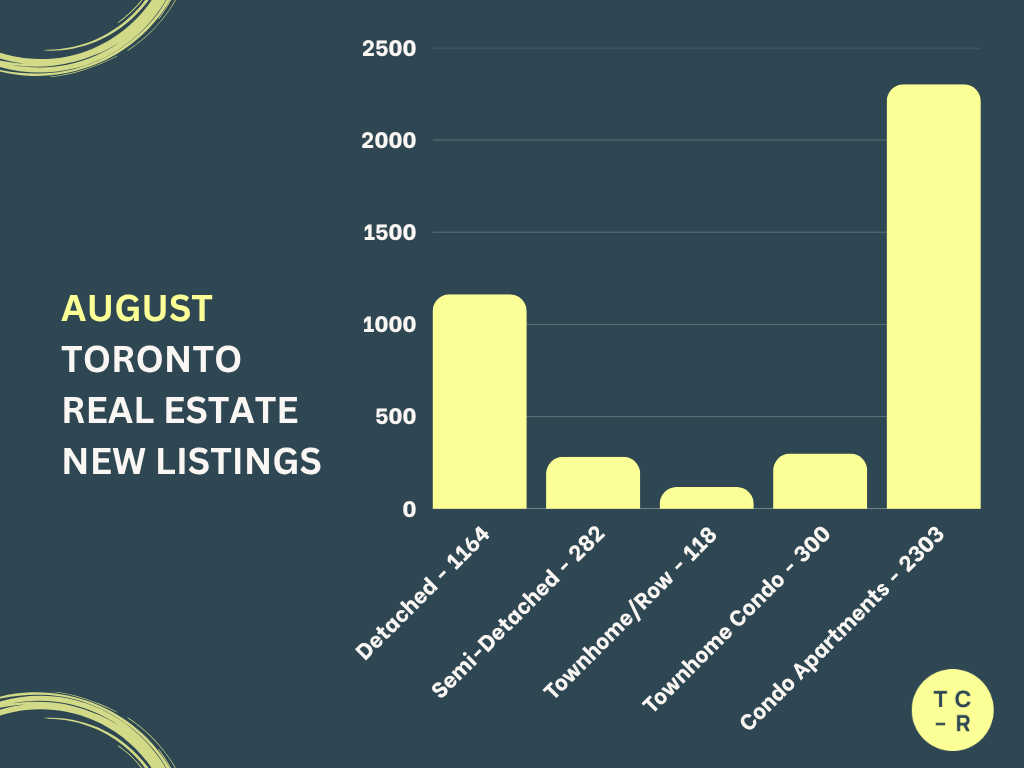
Detached Homes
1,435 → 1,164 (18.9% decrease)
Semi Detached Homes
330 → 282 (14.5% decrease)
Freehold Townhomes
154 → 118 (23.4% decrease)
Condo Townhomes
340 → 300 (11.8% decrease)
Condo Apartments
2,690 → 2,303 (14.4% decrease)
Key Takeaway
New listings declined across every property type in August.
The largest percentage decline came from freehold townhomes, where new listings dropped 23.4% compared to July.
Detached homes declined 18.9%, condo apartments fell 14.4%, semi-detached homes decreased 14.5% and condo townhomes saw the smallest decline at 11.8%.
This continues the trend we saw in July.
Fewer and fewer properties are coming onto the market as we move through the summer.
That isn't particularly surprising. July and August are traditionally the quietest months of the year for real estate, and many homeowners simply aren't looking to make a major move in the middle of summer.
But what's particularly interesting is that sales also declined significantly during the same period.
So while buyers were less active, sellers were also much less active.
That's going to become even more important when we look at active inventory.
📊 ACTIVE LISTINGS

Detached Homes
2,607 → 2,401 (7.9% decrease)
Semi Detached Homes
459 → 422 (8.1% decrease)
Freehold Townhomes
225 → 213 (5.3% decrease)
Condo Townhomes
727 → 683 (6.1% decrease)
Condo Apartments
5,228 → 4,938 (5.5% decrease)
Key Takeaway
Active inventory declined across every property type for the second consecutive month.
Detached homes saw a 7.9% decline, semi-detached homes dropped 8.1%, condo townhomes fell 6.1%, condo apartments decreased 5.5% and freehold townhomes declined 5.3%.
This is probably one of the more interesting parts of the August report.
Despite sales slowing considerably, we're not seeing active inventory build up.
In fact, the opposite is happening.
There were fewer properties available at the end of August than there were at the end of July, continuing the decline we saw last month.
That doesn't mean the market is suddenly tight. Buyers still have plenty of options, particularly in the condo apartment market, where almost 5,000 properties remained actively listed.
But it does suggest that the summer slowdown has been happening on both sides of the market.
📊 SALES

Detached Homes
691 → 550 (20.4% decrease)
Semi Detached Homes
233 → 159 (31.8% decrease)
Freehold Townhomes
95 → 45 (52.6% decrease)
Condo Townhomes
154 → 120 (22.1% decrease)
Condo Apartments
1,054 → 885 (16.0% decrease)
Key Takeaway
Sales declined across every property type in August.
Freehold townhomes experienced the largest decline, with sales falling 52.6% compared to July.
Semi-detached sales dropped 31.8%, detached sales declined 20.4%, condo townhome sales fell 22.1% and condo apartment sales decreased 16.0%.
Those are significant month-to-month declines.
But once again, context matters.
July and August are typically the slowest months of the year for Toronto real estate, so a significant reduction in transactions during this period isn't necessarily a sign that the market is suddenly in trouble.
What is notable is that August didn't simply see fewer sales.
It also saw fewer listings and less active inventory.
So while buyer activity clearly slowed, sellers weren't flooding the market with new properties either.
📊 AVERAGE PRICE

Detached Homes
$1,547,928 → $1,525,749 (1.4% decrease)
Semi Detached Homes
$1,122,326 → $1,110,639 (1.0% decrease)
Freehold Townhomes
$1,047,107 → $1,026,018 (2.0% decrease)
Condo Townhomes
$756,921 → $712,296 (5.9% decrease)
Condo Apartments
$672,807 → $651,648 (3.1% decrease)
Key Takeaway
Average prices declined across every property type in August.
The good news, depending on your perspective, is that the declines were relatively modest in the freehold market.
Detached home prices declined 1.4%, semi-detached prices fell 1.0% and freehold townhomes decreased 2.0%.
The larger decline came from condo townhomes, where the average price fell 5.9%.
Condo apartments also declined, with the average price dropping 3.1% from July.
As always, I would be careful about reading too much into a single month's average price.
The average price can move around significantly depending on the mix of properties that sell during the month.
For example, if more lower-priced homes sell one month and more expensive homes sell the next, the average can change considerably without every individual property suddenly becoming more or less valuable.
That said, the August numbers do reinforce something we've been seeing throughout the summer:
Buyers remain price-conscious and selective.
Sellers need to be realistic about pricing, especially when buyers have time to shop around and compare their options.
📊 DAYS ON MARKET BEFORE SOLD

Detached Homes
29 → 30 days (3.4% increase)
Semi Detached Homes
24 → 27 days (12.5% increase)
Freehold Townhomes
26 → 28 days (7.7% increase)
Condo Townhomes
35 → 40 days (14.3% increase)
Condo Apartments
37 → 39 days (5.4% increase)
Key Takeaway
Homes generally took longer to sell in August, continuing the trend we saw in July.
Condo townhomes experienced the largest increase, moving from 35 to 40 days on market.
Semi-detached homes increased from 24 to 27 days, freehold townhomes moved from 26 to 28 days and condo apartments increased from 37 to 39 days.
Detached homes saw the smallest change, increasing from 29 to 30 days.
The overall message is pretty consistent.
Buyers are taking their time.
There's less urgency in the market, which gives buyers more opportunity to compare properties, negotiate and wait for the right home at the right price.
For sellers, this makes pricing and presentation particularly important.
A property can absolutely still sell in this market, but buyers aren't necessarily going to rush to make a decision.
So, What Does All of This Mean?
August continued the summer slowdown we started seeing in July.
New listings declined.
Active listings declined.
Sales declined across every property type.
Average prices softened across the board.
And homes generally took longer to sell.
On the surface, that might sound pretty negative.
But I think the bigger story is a little more nuanced.
July and August are typically the slowest months of the year for Toronto real estate.
So seeing activity decline during these two months isn't particularly surprising.
What's more interesting is what happened with inventory.
If buyers were slowing down while sellers continued listing homes at the same pace, we'd expect active inventory to continue climbing.
Instead, active listings declined across every property type for the second month in a row.
That's telling us something.
Both buyers and sellers have slowed down.
Sellers aren't rushing to put their homes on the market, and buyers aren't rushing to buy them.
It's almost as if the entire market collectively decided that summer could wait.
And honestly, that's not necessarily a bad thing.
A slower market can give buyers more time to think, compare properties and negotiate.
For sellers, it means pricing correctly from the beginning becomes even more important. When buyers have time and options, an overpriced property can sit while a well-priced property still gets attention.
The August numbers also show that the condo market continues to have a significant amount of available inventory.
Almost 5,000 condo apartments remained actively listed at the end of August, while sales were down 16% from July.
That gives condo buyers plenty of choice and reinforces the importance of realistic pricing for condo sellers.
Overall, I wouldn't look at August and say, "The Toronto real estate market is crashing."
I would say:
The Toronto real estate market had a slow summer.
And that's pretty much what we would expect during July and August.
The more meaningful story will come from what happens when the market moves beyond the traditional summer slowdown.
For now, though, the numbers tell us that both sides of the market have taken their foot off the gas.
Buyers are being selective.
Sellers are being cautious.
Inventory is coming down.
And properties are taking a little longer to sell.
So if you're thinking about buying or selling, the answer isn't simply "the market is up" or "the market is down."
It depends on what you're buying, what you're selling, where you're located and what your individual goals are.
That's where having an actual strategy becomes important.
Ok! That's it for now. Thanks for reading and have a great day! 👋 - Tyson CR
Want to know what the current value of your home is or what's going on in your neighbourhood?
Please feel free to reach out! I'm happy to prepare a completely free, no obligation custom market report just for you.
If you or anyone is thinking of a move don't be shy and reach out.
After all, everyone's individual situation requires an individual and unique strategy and plan.
Subscribe to receive the latest blog posts to your inbox every month.


